
After I learnt to do a direct closure as an intern, I turned my attention to the next most challenging reconstruction – the wedge excision. Doing a wedge excision on an eyelid was way too scary. I was also scared of how much the lip bleeds. So, I lined up a wedge excision on an ear and convinced my registrar at the time to supervise/hold my hand. The operation went fine, but it looked like this afterwards:
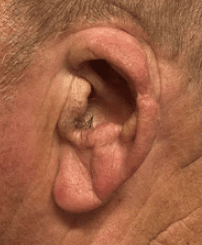
There are two big issues here – there is some notching of the helical rim, and the ear appears cupped. Despite this, I continued my ear wedge excision journey. Whilst I learnt how to avoid the notching, I still got this cupped look unless the skin cancer that I was removing was really small.
And then I found my favourite operation – the antia-buch flap. I now use antia-buch flaps for most helical rim lesions to avoid this cupping.
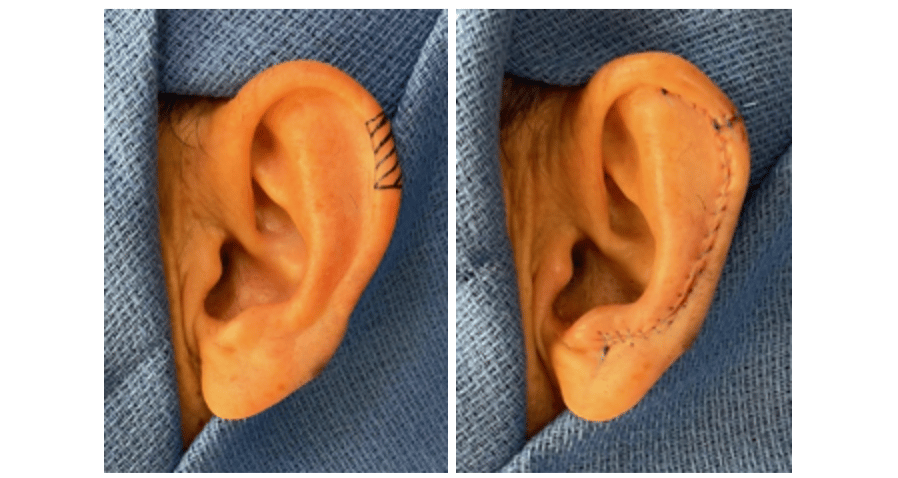
But, the wedge excision is still in my arsenal when approaching ear reconstruction. My indication is quite narrow and the following three factors must be present:
For some bizarre reason, our lobules get bigger as we age. We can use this to our advantage when cutting out skin cancer. Here is a perfect case:
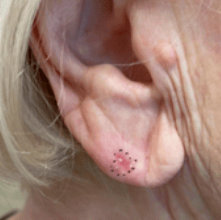
This is a small lesion on the lobule. She also has excess lobule. The giveaway for this is the vertical crease that has formed just medial to the lesion. The lobule has grown so much that it has run out of room and folded in on itself!
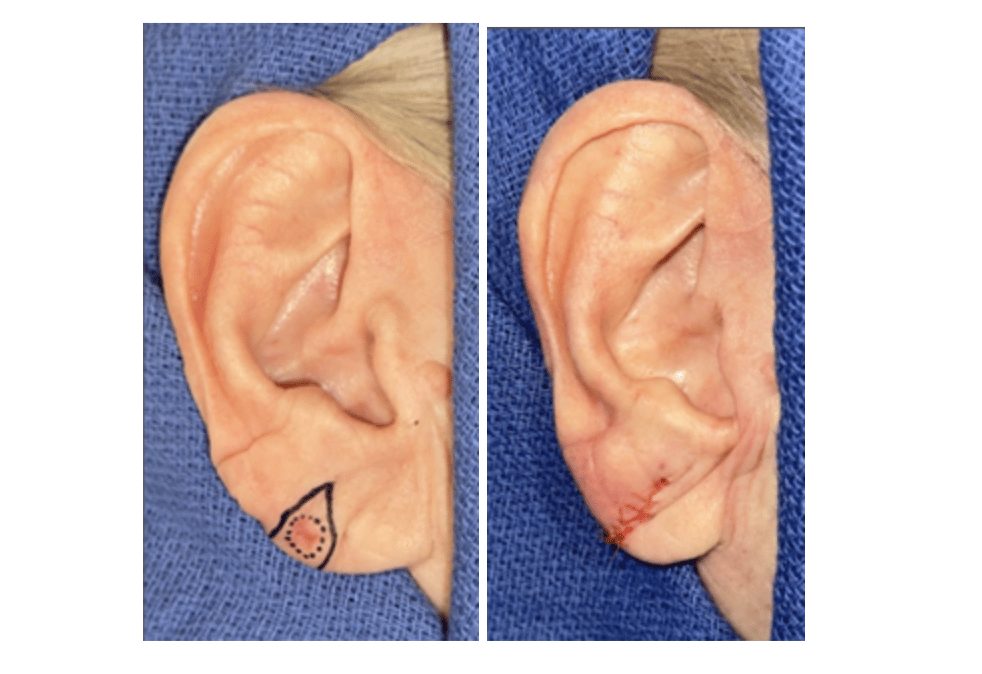
Technical aspects
I use dissolvable sutures in the ear. I used Novafil (a non-dissolvable stitch) for many years. I started to use Vicryl Rapide (a dissolvable stitch) when I operated on patients who lived far away. I saw no difference in their results so I changed my practice.
The 3-4 stitches around the rim are the most important. I always aim to overdo the wound eversion here to avoid notching. This used to be the only area on the body where I did horizontal mattress sutures to accentuate this wound eversion. I don’t feel the need to do this anymore, but it’s not a bad idea if you are at all concerned. I do these stitches first, to set the position of the rim, and then I do a running stitch anteriorly and posteriorly.
Until next time,
NS